Envie-nos um e-mail :
info@labcompanion.cn
-

-

Solicitando uma chamada :
+86 18688888286

In industrial manufacturing and R&D, "environmental adaptability" is a core product quality indicator. High-precision sectors like electronics, automotive, and aerospace demand exceptional product stability under severe temperature fluctuations. The three-chamber thermal shock chamber, a professional tool for simulating extreme temperature changes, has become essential for enterprises to ensure product reliability. This article analyzes this key testing equipment.
I. What is a Three-Chamber Thermal Shock Chamber?
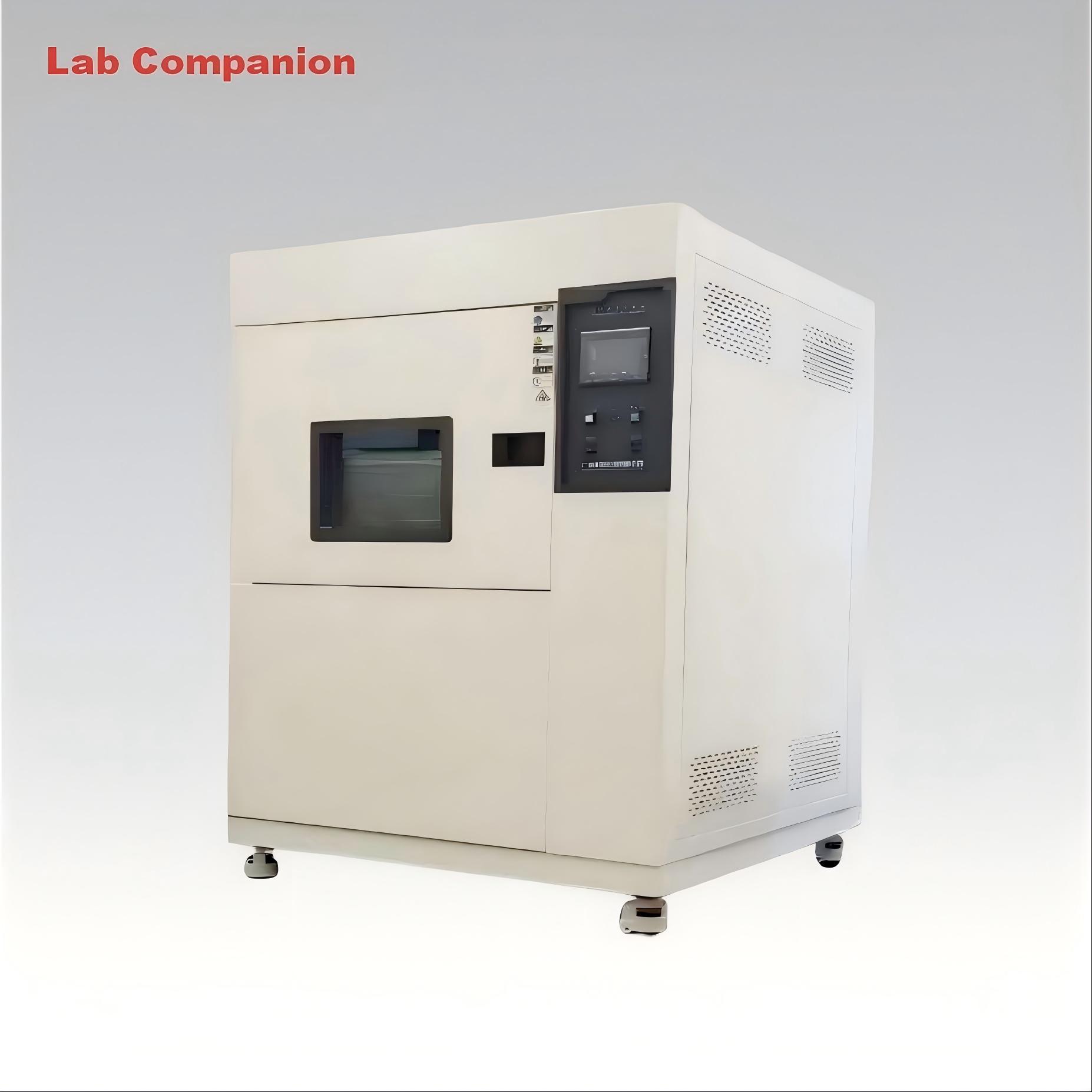
A three-chamber thermal shock chamber conducts thermal shock tests by rapidly switching between high and low temperature environments. Its core is the independent "high-temperature + low-temperature + test chamber" structure, which enables faster temperature changes and precise control compared to two-chamber designs (shared high-low temperature chamber), avoiding transitional temperature interference and replicating real extreme conditions.
Key parameters: temperature range (-40℃~150℃ for high-temp chamber, -60℃~ambient for low-temp), shock rate (>10℃/s max), test chamber volume, and temperature uniformity (≤±2℃). These are customizable per industry standards.
II. Core Working Principle: Rapid Temperature "Energy Switching"
Its operation relies on "independent temperature control + rapid switching", with four key steps:
1. Zoned Control: High-temp chamber uses electric heating/hot air; low-temp chamber uses liquid nitrogen/cascade refrigeration. Both employ independent closed-loop control for stability.
2. Sample Placement: Sample is placed on a movable rack in the ambient-temperature test chamber initially.
3. Shock Cycle: Rack moves sample between high/low-temp chambers per program, simulating "high-low-high" cycles.
4. Data Monitoring: Built-in sensors record real-time temperature and sample performance for analysis.
Compared to two-chamber models, it eliminates temperature balance time (boosting efficiency by 30%+), avoids cross-contamination, and ensures more reliable results.
III. Core Advantages: Precision, Efficiency, and Stability
- Extreme Temp Range: -60℃~180℃, 15℃/s max rate, simulating plateaus/polar/aviation conditions.
- Precise Control: No temperature gradient; uniform heating/cooling, repeatability error ≤±1℃.
- High Efficiency: No chamber transition waits, ideal for batch sample screening.
- Wide Applicability: Suitable for electronics, automotive parts, aerospace components.
IV. Typical Application Scenarios: Full-Link Coverage from Laboratory to Production Line
Its core role is early defect detection, covering R&D, sampling, and quality tracing. Key applications focus on high-reliability industries:
1. Electronics and Electrical Industry: "Extreme Test" for Components
Electronic components (chips, capacitors, PCBs) face frequent temperature changes. This test reveals thermal expansion/contraction defects (solder cracks, package aging). For example, 5G base station chips undergo 1,000 cycles at -40℃~85℃ for climatic adaptability.
2. Automotive Industry: "Environmental Adaptability Verification" for Vehicles and Parts
Automobiles endure -30℃~40℃ cross-regional temp swings, demanding durable components. The chamber tests headlights, battery packs, displays, and seals. New energy vehicle battery packs undergo -20℃~60℃ shocks to verify charging safety; seals are tested for deformation/leakage resistance.
3. Aerospace and Military Industry: "Reliability Guarantee" in Extreme Environments
Aerospace equipment (-50℃~100℃ liftoff temp changes) requires rigorous testing. Satellite solar panels undergo 2,000 cycles at -60℃~150℃ for space stability; aircraft black boxes are tested to ensure crash data preservation.
4. New Materials and Packaging Industry: "Pre-Screening" for Performance and Safety
New materials (aerospace titanium alloys) use the test to verify mechanical stability. Food/pharmaceutical packaging (aluminum foil, glass) is tested to prevent damage/leakage during refrigeration/transport.
V. Conclusion: The "Invisible Guardian" of Reliability Testing
The chamber’s value lies in simulating extreme environments to pre-test products, reducing after-sales risks and boosting competitiveness. As manufacturing advances, it has evolved from a niche tool to a standard asset for R&D and quality control.
For temperature reliability testing, select a chamber with parameters matching your products—pre-emptive defect detection is far more effective than post-failure fixes.


 Obter uma cotação
 Rede IPv6 suportada