Envie-nos um e-mail :
info@labcompanion.cn
-

-

Solicitando uma chamada :
+86 18688888286

ESS is Stress Screening, Not Product Grading A common misconception about ESS is that it acts as a sorting gate to separate good units from defective ones, approving qualified products and blocking failures. While this sounds intuitive, it misrepresents the core purpose of ESS.
ESS (Environmental Stress Screening) is designed to trigger and expose latent process defects: voids in solder joints, cold solder joints, batch-to-batch raw material variations, assembly-induced stress, and residual contaminants. These defects share one key trait: products function normally under ambient conditions and only reveal failures when subjected to environmental stress. When screened properly, good units should suffer no performance degradation or loss of life margin — this is the non-negotiable boundary for screening profile design. If ESS is treated as a grading process and stress levels are continuously raised, the service margin of conforming products will be compromised.
Lab Companion, rooted in China with its base in Dongguan, has specialized in environmental reliability test equipment for over two decades. Its ESS chambers follow the fundamental logic of stress screening and deliver stable, repeatable test performance to safeguard product reliability before shipment. This article clarifies the differences between ESS and reliability validation, explains the principles of thermal screening, and provides guidance on equipment selection and profile development.
ESS is integrated into the manufacturing workflow for finished or semi-finished products before delivery. Its goal is to identify individual units within a batch prone to early failure. Reliability validation targets the product design itself and runs during the R&D phase, verifying whether the design meets long-term lifespan requirements. Confusing the two often leads to misclassifying manufacturing process issues as design flaws, and vice versa.
ESS performs a “subtraction”: activating hidden defects and removing abnormal samples. Reliability validation focuses on “proof”: using accelerated testing and statistical analysis to demonstrate sufficient reliability margin in the design.
ESS returns a simple pass-or-reject judgment for each individual sample. Reliability validation outputs statistical data including failure rates, lifespan distributions and confidence intervals. These distinct goals create different equipment priorities: ESS prioritizes batch consistency, while reliability validation emphasizes measurement accuracy and traceability.
Temperature cycling generates alternating mechanical stress through thermal expansion and contraction, exposing risks in soldering, assembly and material performance simultaneously. Compared with electrical-only stress, thermal cycling covers more failure modes and delivers higher screening efficiency.
High-volume manufacturing defects such as cold solder joints, voids, foreign inclusions and assembly compression are mostly stress-sensitive. They remain dormant at room temperature but emerge rapidly under repeated thermal cycling — making thermal cycling the backbone of most ESS profiles.
Temperature limits, ramp rates and cycle counts can be locked into a standardized screening profile and maintained consistently across batches. Quantifiable test conditions give screening results statistical validity and enable uniform benchmarking across multiple production lines.
Thermal screening is not universal. It has limited effectiveness on defects such as fretting wear and pure mechanical fatigue, which typically require vibration or combined stress screening for effective detection. Recognizing these boundaries enables rational screening plan design.
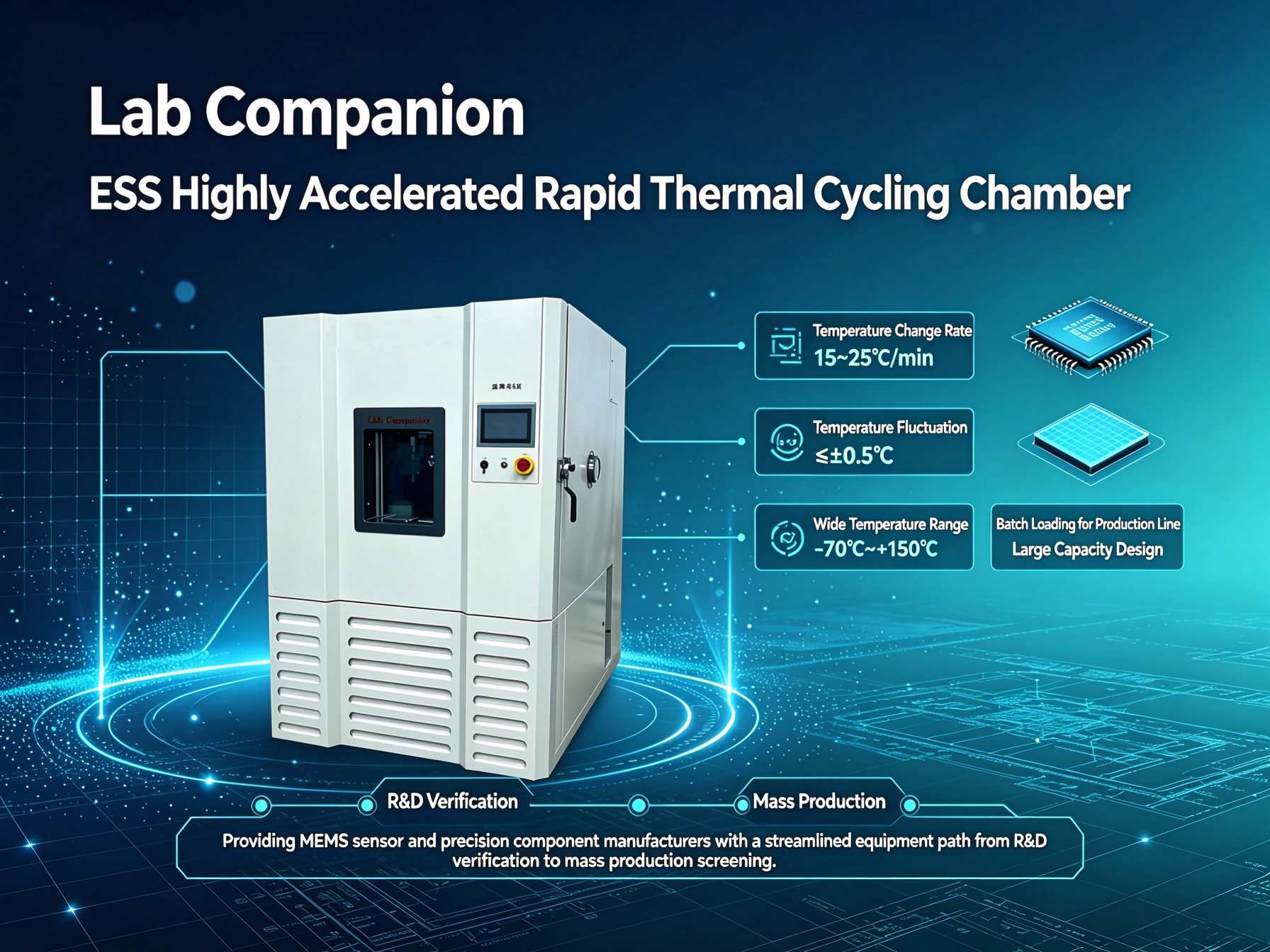
Standard chambers cover -70℃ to +150℃ with selectable linear ramp rates of 5℃/min, 10℃/min and 15℃/min. Users can customize screening profiles according to product characteristics and defect types to apply stress that activates latent defects without harming the life margin of good units.
Temperature fluctuation ≤ ±0.3℃ and temperature deviation ≤ ±2℃. The air duct and circulating airflow are optimized to maintain stable, even thermal distribution even with multi-layer full loading. Since ESS is a batch process, every unit in the same batch must experience identical stress; otherwise, screening conclusions lose statistical validity.
Custom multi-layer sample racks are supported to accommodate large quantities per batch, reducing reloading frequency and temperature recovery waiting time. Screening cycles can be aligned with production takt time. Custom fixtures are available for irregularly sized or varied test specimens to maximize loading efficiency.
Temperature curves and full test data are automatically recorded and archived for each batch to satisfy quality traceability requirements. Interfaces including MES, EAP and SECS-GEM are optional to connect with automated production lines, enabling automatic result upload and closed-loop quality management.
A two-tier profile strategy is recommended: Level 1 is routine screening with moderate stress for mass production batches to detect common process risks. Level 2 is enhanced screening reserved for batches with volatile raw materials or unstable processes to intensify defect activation. Tiered screening avoids subjecting normal products to unnecessary high stress.
Screening performance cannot be judged by rejection rate alone. An excessively high rejection rate may indicate overstressing that damages conforming products; an overly low rejection rate may mean stress is insufficient to expose latent risks. The proper practice is to sample and retest product performance after screening to confirm no degradation, then evaluate whether the rejection rate falls within a reasonable range.
The validity of ESS relies fundamentally on uniform conditions across the batch. During supplier evaluation, focus on thermal uniformity under full-load conditions, temperature recovery speed and long-term stability, and request full-load mapping reports.
ESS is embedded into assembly lines and cannot be selected in isolation from production rhythm. Batch capacity, ramp-up/ramp-down duration, dwell time and changeover intervals jointly determine whether the screening station becomes a production bottleneck. Share your takt-time requirements with Lab Companion to reverse-calculate the required chamber volume, ramp rate and loading structure. Customization is available for chamber size, temperature zones, communication protocols and sample racks.
ESS chambers are often deployed at critical production nodes, where unplanned downtime directly impacts shipment schedules. With three R&D and manufacturing bases across China in Dongguan, Kunshan and Chongqing, a production footprint exceeding 6,000 ㎡ and an annual output of approximately 2,000 environmental test systems, Lab Companion leverages a nationwide service network for rapid response and uninterrupted production support.
ESS is not a product grading tool but a frontline screening method for latent manufacturing defects. The core principle of profile design is to activate hidden defects while protecting the life margin of conforming products. The baseline for equipment operation is consistent test conditions across large batches.
Lab Companion’s ESS chambers combine wide temperature coverage, flexible ramp rates, high-precision thermal control and high-capacity multi-layer loading, helping customers implement scientific and reliable stress screening workflows to strengthen pre-shipment product reliability. Moving forward, Lab Companion will continue to deepen its expertise in environmental reliability testing and deliver stable test equipment and technical support for global customers from China.


 Obter uma cotação
 Rede IPv6 suportada