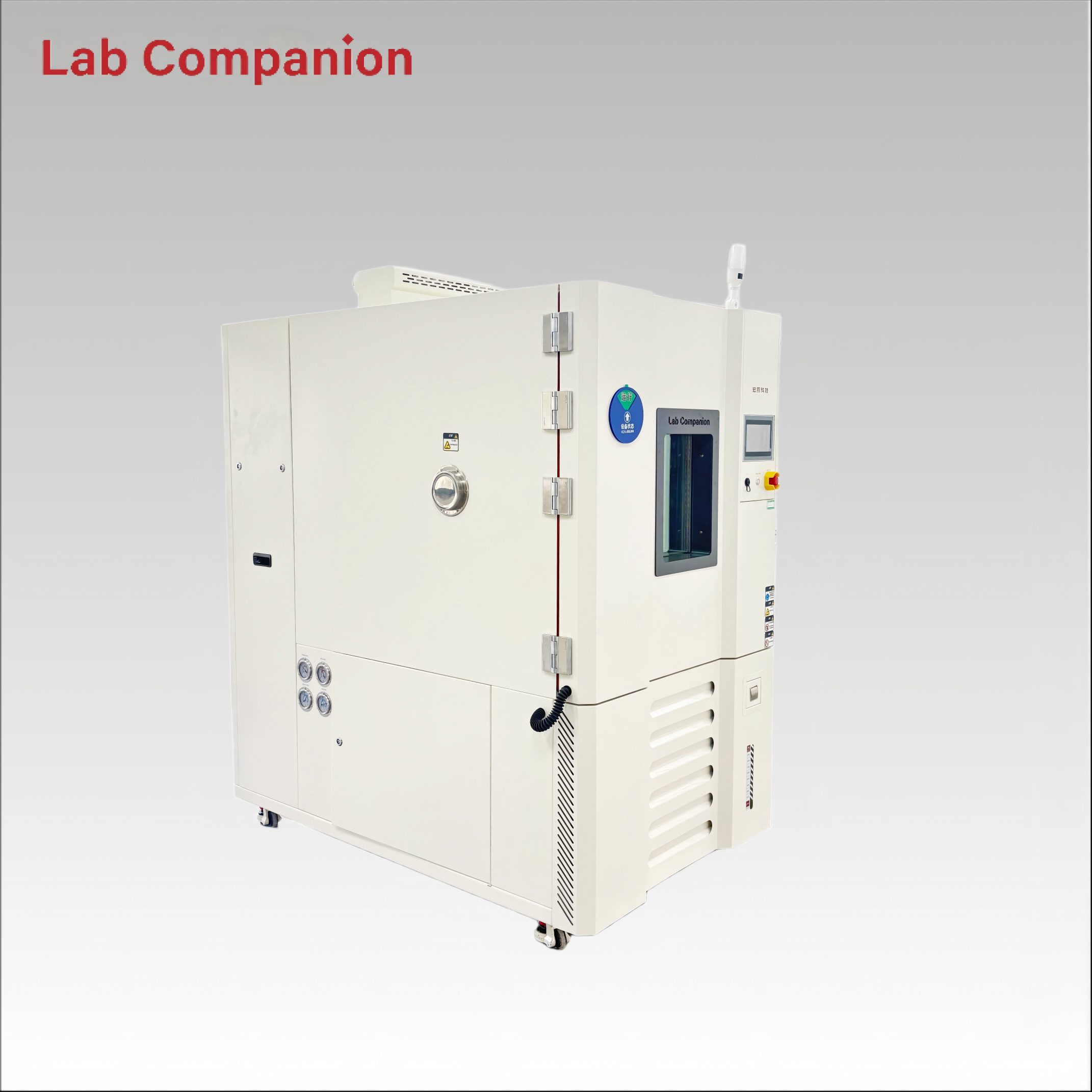
In the field of environmental reliability testing, a high-performance high & low temperature rapid thermal cycling chamber serves as core equipment for enterprises to control product quality and verify product reliability. As a leading brand deeply engaged in the environmental testing equipment industry for many years, Lab Companion boasts in-depth insights into testing demands across various industries and extensive experience in product R&D and practical application. We have accurately identified the core characteristics of a reliable and efficient high & low temperature rapid thermal cycling chamber. From Lab Companion’s professional perspective, this article systematically breaks down the five core performance indicators that must be focused on during the selection process, providing professional guidance for industry customers to help them make accurate selections, avoid procurement pitfalls, and make informed decisions that align with their actual needs.
1. Temperature Range & Rate of Temperature Change – Define Testing Boundaries and Determine Testing Efficiency
Temperature range and rate of temperature change are the basic performance benchmarks of high & low temperature rapid thermal cycling chambers. They directly determine the breadth of the equipment’s application scenarios and affect the efficiency and pace of testing processes, making them the primary consideration in equipment selection.
Temperature Range: The key is to ensure the equipment’s temperature range fully covers the extreme high and low temperature environments that products may encounter throughout their service life, avoiding limited testing scenarios due to insufficient range. Lab Companion high & low temperature rapid thermal cycling chambers offer a temperature interval of -70℃ to +150℃ and even wider ranges, with fully linear controllability throughout the process—not just transient peak values. This ensures stable and precise temperature regulation during testing, adapting to the testing needs of electronics, automotive, military, semiconductor and other industries.
Rate of Temperature Change: During selection, priority should be given to distinguishing between no-load rate and loaded rate—the latter is more consistent with actual testing scenarios (simulating the heat capacity of real samples) and thus more valuable for reference. A high temperature change rate (e.g., 15℃/min and above) can significantly shorten testing cycles and improve testing efficiency, provided that temperature uniformity and stability are not compromised; otherwise, test data will be distorted. Equipped with a high-efficiency cascade refrigeration system and independently developed precise temperature control algorithms, Lab Companion achieves stable and nominal rapid linear temperature changes even under loaded conditions, truly realizing "efficient testing without compromise" and effectively enhancing testing efficiency while reducing time costs for customers.
2. Temperature Uniformity & Fluctuation – Lay the Foundation for Reliable Test Data
Temperature uniformity and fluctuation are core indicators for evaluating the consistency and stability of the internal testing environment. They directly affect the repeatability and authority of test results, and are critical prerequisites for ensuring valid test data.
Temperature Uniformity: Refers to the consistency of temperatures at various testing points within the equipment’s working space (industry standard: ≤±2.0℃). Poor uniformity will result in samples of the same batch being exposed to different thermal stress environments, rendering test conclusions meaningless and even misleading product R&D and quality judgments.
Temperature Fluctuation: Refers to the variation amplitude of the control point temperature over time (industry standard: ≤±0.5℃). Excessive fluctuation introduces additional thermal stress interference to samples, compromising the accuracy and rigor of testing.
Lab Companion Practice: Leveraging Computational Fluid Dynamics (CFD) technology, Lab Companion optimizes air duct structure design and employs scientifically arranged high-precision sensors to maintain exceptional temperature uniformity and minimal fluctuation even under full-load testing conditions. All equipment performance data is verified in strict accordance with national standards such as GB/T 10592, eliminating "nominal-only parameters" and ensuring every set of test data is authentic, reliable and traceable.
3. Load Capacity & Thermal Load Impact – Verify the Equipment’s Practical Performance
Most equipment specifications on the market are tested under ideal no-load conditions. In actual testing, however, the volume, weight and heat generation (thermal load) of samples directly affect the equipment’s real operational performance—this is also the core criterion for judging whether equipment performs as advertised.
Real Load Evaluation: During selection, clarify the maximum sample size, weight and heat dissipation power (W) that the equipment can support. Especially for electronic products requiring powered testing, the heat generated during operation must be fully offset by the equipment’s cooling capacity to ensure stable low-temperature testing and prevent test failure due to unbalanced thermal load.
Loaded Performance Verification: To ensure customers purchase equipment matching their actual testing needs, Lab Companion proactively recommends and supports customers in conducting simulated load tests—installing heating devices equivalent to sample thermal loads inside the chamber to on-site verify whether the equipment’s temperature change rate, temperature uniformity and extreme low-temperature performance still meet standards under real working conditions. This completely eliminates the problem of "qualified under no load but invalid under load" and guarantees robust practical performance.
4. Control System & Data Integrity – The Intelligent "Brain" of Operation and Guardian of Compliant Testing
With the advancement of laboratory intelligence and standardization, advanced control systems and rigorous data management systems have become essential requirements for modern environmental testing laboratories. For regulated industries in particular, data compliance is of paramount importance.
Intelligent Control System: A high-quality control system requires three core capabilities—high-precision temperature control, an intuitive and user-friendly interface, and powerful multi-segment programming functions. It should also be equipped with comprehensive safety protection and fault self-diagnosis features to reduce operational complexity and avoid operational risks. Lab Companion adopts an independently developed intelligent controller that supports complex temperature profile programming and pre-installs multiple internationally recognized testing standard programs. It features convenient operation and precise temperature control, adapting to the customized testing needs of various industries.
Data Integrity & Traceability: For regulated industries such as automotive, medical, military and semiconductor, equipment software must strictly comply with international regulations including FDA 21 CFR Part 11, with functions such as electronic signatures, complete audit trails, hierarchical authority management and tamper-proof data storage to ensure the compliance and traceability of test data. Lab Companion provides targeted software options meeting such stringent requirements, fully safeguarding the compliance of customers’ test data and supporting smooth passage of various industry audits.
5. Long-Term Reliability, Energy Efficiency & Service Network – Evaluate Full Lifecycle Value
High & low temperature rapid thermal cycling chambers are long-term investment equipment. Their long-term operational stability, energy consumption and after-sales support directly determine the equipment’s full lifecycle cost—an easily overlooked yet critical indicator in selection.
Long-Term Operational Reliability: The long-term stability of equipment relies on the quality of key components (e.g., compressors, controllers, sensors) and overall design lifespan. Lab Companion insists on adopting world-renowned brand core components, combined with stringent product aging tests and Factory Acceptance Tests (FAT), to ensure each delivered unit features high reliability and long service life, minimizing downtime and ensuring uninterrupted testing operations.
Operational Energy Efficiency: High energy consumption constitutes a major part of long-term operating costs, especially for laboratories operating 24/7, where energy-saving performance directly impacts operational expenses. Incorporating variable frequency regulation technology and high-efficiency heat exchange systems, Lab Companion’s energy-saving designs significantly reduce energy consumption while maintaining equipment performance, helping customers cut long-term operating costs and achieve the dual goals of "efficient testing and green energy conservation".
Full Lifecycle Service Support: A comprehensive service system guarantees the continuous and stable operation of equipment. Lab Companion has built a global service network providing full lifecycle support—from pre-sales professional consultation and customized solution design, to in-sale installation, commissioning and operation training, and post-sales rapid response, fault repair and regular preventive maintenance plans. We fully address customers’ concerns, allowing them to focus on their core testing work.
Conclusion: Anchor Value with Professional Indicators, Choose a Long-Term Reliable Testing Partner
Selecting a high & low temperature rapid thermal cycling chamber essentially means choosing a long-term, trustworthy testing partner. This requires moving beyond the misconception of "nominal parameters", starting from actual testing needs, and thoroughly examining the equipment’s core performance, loaded practical capabilities, intelligent control and compliance, as well as full lifecycle costs and service support.
Rooted in its profound understanding and relentless pursuit of the above five core indicators, Lab Companion has built its core competitiveness in products and services. Every Lab Companion high & low temperature rapid thermal cycling chamber is not only a high-performance testing instrument, but also an integrated testing solution embodying the brand commitment of "precision, reliability, efficiency and compliance". Choosing Lab Companion means selecting reliable equipment that withstands professional verification and meets practical needs, as well as a long-term partner dedicated to enhancing your product reliability and empowering high-quality industry development. On the path to pursuing quality, let professional indicators guide the way—Lab Companion stands with you to build a solid line of defense for product quality.






 Obter uma cotação
 Rede IPv6 suportada